Non-Sporting Group
Breed Standard
General Appearance
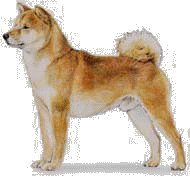 The Shiba is
the smallest of the Japanese native breeds of dog and was originally developed
for hunting by sight and scent in the dense undergrowth of Japan's mountainous
areas. Alert and agile with keen senses, he is also an excellent watchdog and
companion. His frame is compact with well-developed muscles. Males and females
are distinctly different in appearance: males are masculine without coarseness,
females are feminine without weakness of structure.
The Shiba is
the smallest of the Japanese native breeds of dog and was originally developed
for hunting by sight and scent in the dense undergrowth of Japan's mountainous
areas. Alert and agile with keen senses, he is also an excellent watchdog and
companion. His frame is compact with well-developed muscles. Males and females
are distinctly different in appearance: males are masculine without coarseness,
females are feminine without weakness of structure. Size, Proportion, Substance
Males 14½ inches to 16½ inches at withers. Females 13½ inches to 15½ inches. The preferred size is the middle of the range for each sex. Average weight at preferred size is approximately 23 pounds for males, 17 pounds for females. Males have a height to length ration of 10 to 11, females slightly longer. Bone is moderate. Disqualification--Males over 16½ inches in dogs and under 14½ inches. Females over 15½ inches and under 13½ inches.
Head
Expression is good natured with a strong and confident gaze. Eyes are somewhat triangular in shape, deep set, and upward slanting toward the outside base of the ear. Iris is dark brown. Eye rims are black. Ears are triangular in shape, firmly pricked and small, but in proportion to head and body size. Ears are set well apart and tilt directly forward with the slant of the back of the ear following the arch of the neck. Skullsize is moderate and in proportion to the body. Forehead is broad and flat with a slight furrow. Stop is moderate. Muzzle is firm, full, and round with a stronger lower jaw projecting from full cheeks. The bridge of the muzzle is straight. Muzzle tapers slightly from stop to nose tip. Muzzle length is 40% of the total head length from occiput to nose tip. It is preferred that whiskers remain intact. Lips are tight and black. Nose is black. Bite is scissors, with a full complement of strong, substantial, evenly aligned teeth.
Serious Fault: Five or more missing teeth is a very serious fault and must be penalized.
Disqualification--Overshot or undershot bite.
Neck, Topline and Body
Neck is thick, sturdy, and of moderate length. Topline is straight and level to the base of the tail. Body is dry and well muscled without the appearance of sluggishness or coarseness. Forechest is well developed. Chest depth measured from the withers to the lowest point of the sternum is one-half or slightly less than the total height from withers to ground. Ribs are moderately sprung. Abdomen is firm and well tucked-up. Back is firm. Loins are strong. Tail is thick and powerful and is carried over the back in a sickle or curled position. A loose single curl or sickle tail pointing vigorously toward the neck and nearly parallel to the back is preferred. A double curl or sickle tail pointing upward is acceptable. In length the tail reaches nearly to the hock joint when extended. Tail is set high.
Forequarters
Shoulder blade and upper arm are moderately anuglated and approximately equal in length. Elbows are set close to the body and turn neither in nor out. Forelegs and feet are moderately spaced, straight, and parallel. Pasterns are slightly inclined. Removal of front dewclaws is optional. Feet are catlike with well-arched toes fitting tightly together . Pads are thick.
Hindquarters
The angulation of the hindquarters is moderate and in balance with the angulation of the forequarters. Hind legs are strong with a wide natural stance. The hock joint is strong, turning neither in nor out. Upper thighs are long and the second thighs short but well developed. No dewclaws. Feet as in forequarters.
Coat
Double coated with the outer coat being stiff and straight and the undercoat soft and thick. Fur is short and even on face, ears, and legs. Guard hairs stand off the body are about 1½ to 2 inches in length at the withers. Tail hair is slightly longer and stands open in a brush. It is preferred that the Shiba be presented in a natural state. Trimming of the coat must be severely penalized. Serious Fault--Long or woolly coat.
Color
Coat color is as specified herein, with the three allowed colors given equal consideration. All colors are clear and intense. The undercoat is cream, buff or gray.
Urajiro (cream to white ventral color) is required in the following areas on all coat colors: on the sides of the muzzle, on the cheeks, inside the ears, on the underjaw and upper throat inside of legs, on the abdomen, around the vent and the ventral side of the tail. On reds: commonly on the throat, forechest, and chest. On blacks and sesames: commonly as a triangular mark on both sides of the forechest. White spots above the eyes permitted on all colors but not required.
Bright orange-red with urajiro lending a foxlike appearance to dogs of this color. Clear red preferred but a very slight dash of black tipping is permitted on the back and tail.
Black with tan points and urajiro. Black hairs have a brownish cast, not blue. The undercoat is buff or gray. The borderline between black and tan areas is clearly defined. Tan points are located as follows: two oval spots over the eyes: on the sides of the muzzle between the black bridge of the muzzle and the white cheeks; on the outside of the forelegs from the carpus, or a little above, downward to the toes; on the outside of the hind legs down the front of the stifle broadening from hock joint to toes, but not completely eliminating black from rear of pasterns. Black penciling on toes permitted. Tan hairs may also be found on the inside of the ear and on the underside of the tail.
Sesame(black-tipped hairs on a rich red background) with urajiro. Tipping is light and even on the body and head with no concentration of black in any area. Sesame areas appear at least one-half red. Sesame may end in a widow's peak on the forehead, leaving the bridge and sides of the muzzle red. Eye spots and lower legs are also red.
Clearly delineated white markings are permitted but not required on the tip of the tail and in the form of socks on the forelegs to the elbow joint, hind legs to the knee joint. A patch of blaze is permitted on the throat, forechest, or chest in addition to urajiro.
Serious fault--Cream, white pinto, or any other color or marking not specified is a very serious fault and must be penalized.
Gait
Movement is nimble, light, and elastic. At the trot, the legs angle in towards a center line while the topline remains level and firm. forward reach and rear extension are moderate and efficient. In the show ring, the Shiba is gaited on a loose lead at a brisk trot.
Temperament
A spirited boldness, a good nature, and an unaffected forthrightness, which together yield dignity and natural beauty. The Shiba has an independent nature and can be reserved toward strangers but is loyal and affectionate to those who earn his respect. At times aggressive toward other dogs, the Shiba is always under the control of his handler. Any aggression toward handler or judge or any overt shyness must be severely penalized.
Summary
The foregoing is a description of the ideal Shiba. Any deviation from the above standard is to be considered a fault and must be penalized. The severity of the fault is equal to the extent of the deviation. A harmonious balance of form, color, movement, and temperament is more critical than any one feature.
DISQUALIFICATIONS
Males over 16½ and under 14½ inches.
Females over 15½ and under 13½ inches.
Overshot or undershot bite.